

If you've ever relied on a yb prefabricated substation to keep a commercial site, industrial facility, or residential development powered, you know how critical these compact, pre-built units are to avoiding costly downtime. As a supplier of these substations, I've spent more than a decade walking alongside clients through emergency repairs, scheduled maintenance, and troubleshooting that prevents small issues from turning into full-out outages. YB substations are designed for easy installation and reliability, but like any electrical equipment, they require timely, informed repairs to stay operational. The good news is that many common problems can be resolved with basic tools, a clear understanding of the unit's design, and a structured approach-no specialized field team required for most routine fixes.
Before diving into repairs, it's vital to clarify: not all yb prefabricated substations are identical. Our lineup includes multiple tailored models to fit different project needs, from compact urban sites to heavy industrial locations. For projects needing a space-saving, flexible unit perfect for tight urban lots, our Pre-assembled Modular Substation is engineered to simplify both installation and later maintenance. If your application requires handling higher voltage levels for large manufacturing plants or utility-scale sites, the HV Prefabricated Substation delivers the robust insulation and load capacity needed for long-term, high-demand use. For projects with 35kV power requirements-common in renewable energy farms or large mining operations-our 35kV Skid Mounted Substation comes pre-wired on a durable steel skid, so you can bring maintenance teams to the unit instead of the other way around. For general-purpose sites needing a balance of size and performance, the Compact Modular Substation is lightweight enough for transport to remote areas while still housing full circuit protection and transformer components. If you're working on a temporary site or a project that requires repositioning, our Skid Mounted Substation offers even greater mobility, with reinforced lifting points for easy relocation. Knowing exactly which model you own will make every repair step smoother, so keep your unit's serial number and model documentation on hand before starting any work.
First, and this cannot be emphasized enough: safety is non-negotiable. Electrical work poses serious risks of shock, burns, or even fatal injury if not done correctly. Before you touch any component, cut the main power supply to the substation at the upstream grid connection, and lock the disconnect switch in the "off" position with a personal padlock. Hang a clear "Danger – Do Not Operate" sign on the disconnect to prevent accidental power restoration while you work. Test all contact points with a non-contact voltage tester to confirm there is no residual current-this small step has saved countless technicians from harm. Wear insulated gloves rated for the voltage level your substation handles, safety goggles, and closed-toe shoes, and work with a buddy if possible; having a second person present ensures help is available if an emergency arises. I always tell our clients and field teams: if you are unsure about any step, stop and reach out to our support team before proceeding. No repair is worth risking your safety.
Now, let's walk through the most common issues our yb prefabricated substation owners face, and how to repair them step by step.

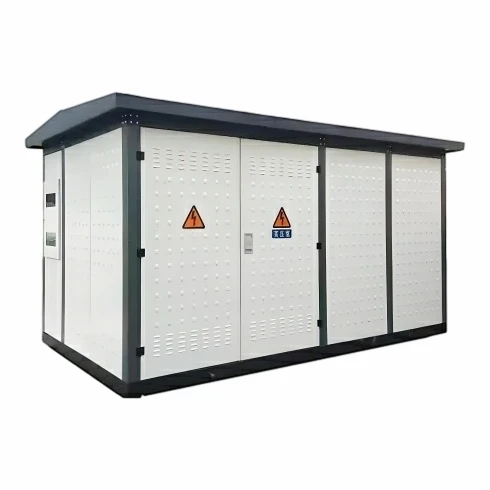
The first and most frequent problem is a total or partial power outage. If the substation's output is down, start by checking the visual indicators inside and outside the unit. Open the substation's access panel (note: many models have lockable panels, so you'll need the matching key) and look at the circuit breakers, fuses, and transformer windings. First, check the main circuit breaker: if it's in the "tripped" position (halfway between "on" and "off"), this is the likely cause of the outage. Resetting it is simple: turn it fully to the "off" position, wait 30 seconds, then flip it back to "on." If it trips immediately after resetting, that's a sign of an underlying issue-either a short circuit downstream, a faulty breaker, or an overloaded transformer. For partial outages, check individual branch circuit breakers: one tripped breaker will cut power to a specific section of the site, while others stay active.
If resetting breakers doesn't work, the next common culprit is a blown fuse. Fuses protect individual circuits from overcurrent, and they can blow due to a sudden power surge, loose wiring, or a faulty connected load. To test a fuse, pull it out of its holder (always make sure power is still disconnected) and inspect the internal wire: if it's broken, blackened, or cracked, it needs to be replaced. It's critical to use a fuse with the exact amperage and voltage rating of your substation-using a higher-rated fuse can lead to component damage, while a lower-rated fuse will blow prematurely. You'll find the correct fuse specs in your unit's owner manual, or you can look them up on our product pages for your model: for example, Skid Mounted Substation fuses have different ratings than Compact Modular Substation fuses, so don't mix them up. Once you have the correct fuse, insert it firmly into the holder, close the access panel, and restore power to test.
Another frequent issue is overheating, which is often caused by poor ventilation or dirty components. YB substations are designed with ventilation slots to keep the transformer and breaker operating at a safe temperature, but if these slots are blocked by debris like leaves, dust, or construction debris, the unit will overheat and trigger a built-in shutdown. Start by shutting off power and opening the ventilation grilles (they're usually on the sides or top of the unit). Use a soft brush or low-powered vacuum to gently remove dirt and debris-never use high-pressure air, as this can bend delicate internal components or push dust deeper into the unit. Overheating can also be caused by a faulty cooling fan, which is present in most HV Prefabricated Substation and 35kV Skid Mounted Substation models. To test the fan, after restoring power (while standing clear of moving parts), listen for a consistent, steady hum. If the fan isn't running, check its electrical connection-loose wires are a common fix-or if that's fine, replace the fan with the compatible part listed in your manual. Overheating left unaddressed can damage the transformer's winding insulation, so address this issue as soon as you notice warning signs like a hot exterior panel or an overheat alarm on the control panel.
Loose wiring connections are another leading cause of intermittent power, overheating, and even electrical fires. Vibration from the substation's operation, or shifts in the unit's mounting (especially for portable models like our Skid Mounted Substation) can cause wires to work themselves loose over time. For this repair, power is still disconnected, and we recommend using a digital multimeter to test continuity between connection points. Start with the main power connections: the lines coming from the grid and the lines going to the building or site. Tighten all terminal screws with a torque wrench set to the manufacturer's specified torque-over-tightening can strip the screw or damage the connection lug, while under-tightening leaves a loose connection that will arc. Check all secondary connections too, including those on circuit breakers, fuses, and the transformer. If you notice any corroded terminals, clean them with a wire brush coated in electrical contact cleaner before re-tightening; corrosion increases resistance, which leads to overheating and voltage drops.
If you're dealing with a faulty control panel, which houses the alarms, metering, and monitoring functions for your yb prefabricated substation, the steps are straightforward. First, remove the control panel cover by unscrewing the mounting screws. Check for loose wires at the panel's terminal block-just like with main power connections, loose wiring here will cause inaccurate readings or failed alarms. If a specific sensor (like the overheat sensor or current sensor) is malfunctioning, it will show a false reading on the control panel's display. You can test a sensor with a multimeter: compare its reading to the value listed in the manual for normal operation. If it's outside that range, replace the sensor with the exact part number from our supplier inventory. For models with digital control panels, also check the circuit board for burn marks or damaged components-small fuses on the board often blow due to power surges, and replacing them is a quick fix if that's the issue.
Sometimes, the issue isn't with internal components at all-it's with the substation's exterior, like damaged panels or a cracked seal. YB substations are built to withstand harsh weather, but impact from construction equipment, falling debris, or extreme temperature shifts can crack the outer panels or the gaskets that seal them. Cracked panels expose internal components to moisture, which can cause rust, corrosion, and short circuits. To repair a damaged panel, first turn off power and disconnect the unit from the grid. Remove the damaged panel by unscrewing the mounting bolts, and clean the area where it attaches to the unit. Install a replacement panel of the same size and material-our Pre-assembled Modular Substation and Compact Modular Substation panels are made from durable powder-coated steel, while our HV and 35kV models use thicker steel for extra protection. Make sure to replace the weather seal gasket when you install the new panel to keep moisture out, and tighten all bolts evenly to avoid warping the panel.
Preventive maintenance is the best way to avoid unexpected repairs, and as a supplier, we always recommend a quarterly inspection schedule for yb prefabricated substations. During each inspection, check for loose connections, clean ventilation slots, test fuses and breakers, and monitor control panel readings. For models that are exposed to saltwater or heavy dust (common in coastal or desert areas), increase inspections to monthly. If your site is in a high-seismic zone, inspect mounting bolts and the skid frame (especially for Skid Mounted Substation models) every six months to ensure they're secure.
If at any point during repair you encounter something that doesn't align with your manual, or if you see signs of severe damage like a bulging transformer casing, burnt wiring insulation, or a control panel that's emitting smoke, stop immediately. These are signs of a major internal fault that requires professional intervention. Our team offers 24/7 support for our clients, and we can connect you with certified technicians who are trained on every model of yb prefabricated substation we supply. We also offer extended repair services for complex issues, as well as genuine replacement parts to ensure your unit continues to operate safely and at peak performance.
When it comes to repairing a yb prefabricated substation, the key is to be methodical, prioritize safety, and use the correct parts for your specific model. Don't cut corners with wiring, fuses, or panels-using non-compatible parts can lead to further damage and create safety hazards. If you're looking to upgrade your current unit to a model that's easier to maintain, or if you're in the market for a new yb prefabricated substation, our lineup has options for every project: from compact urban setups with the Pre-assembled Modular Substation to high-capacity utility units with the HV Prefabricated Substation, and heavy-duty portable units with the Skid Mounted Substation.
For more information about our yb prefabricated substations, including product specifications, maintenance guides, and genuine replacement parts, connect with our team today to discuss your project needs and find the right solution for your site.
References:
- International Electrical Testing Association (NETA). "Standard for Electrical Maintenance, Testing, and Commissioning." NETA Publications, 2022.
- IEEE Standard for Power Substation Maintenance. Institute of Electrical and Electronics Engineers, 2019.
- Pre-Fabricated Substation Design and Operation Guidelines. American Electric Power, 2021.
- Manufacturer's Maintenance Manual: YB Series Prefabricated Substations. AB Power Solutions, 2023.
- Occupational Safety and Health Administration (OSHA). "Electrical Safety in the Workplace." OSHA Publication 3075, 2020.